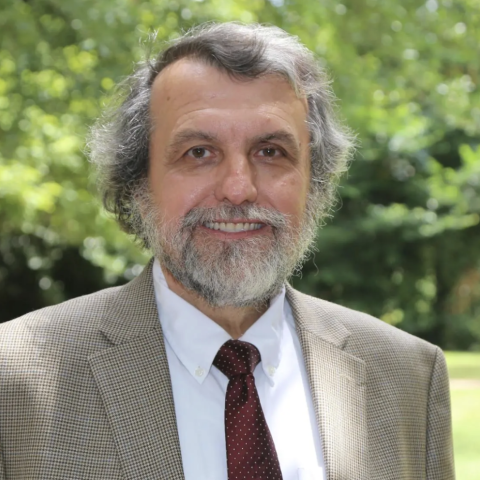
Gabriel Alfonso Rincón-Mora is Motorola Solutions Foundation Professor, Fellow of the National Academy of Inventors (NAI), Fellow of the American Association for the Advancement of Science (AAAS), Fellow of the Institute of Electrical and Electronics Engineering (IEEE), and Fellow of the Institution of Engineering and Technology (IET) for contributions to power-conditioning and energy-harvesting microchips. He was with Texas Instruments in 1994–2004 and has been with the Georgia Institute of Technology since 1999. He was Visiting Professor at National Cheng Kung University in Taiwan in 2011-2019, Director of the Georgia Tech Analog Consortium in 2001-2004, and Director of the TI Analog Fellowship Program in 2001-2015. His body of work includes 12 books, 8 handbooks, 4 book chapters, 44 patents, over 200 articles, 25 educational videos, over 26 commercial power-chip products released to production, 25 educational videos, educational SPICE code for over 200 analog and power circuits, and over 170 keynote addresses, distinguished lectures, and research seminars.
He was inducted into Georgia Tech's Council of Outstanding Young Engineering Alumni, named one of "The 100 Most Influential Hispanics" by Hispanic Business, included in "List of Notable Venezuelan Americans" in Science, and selected IEEE Distinguished Lecturer. He received the National Hispanic in Technology Award, Charles E. Perry Visionary Award, IEEE Charles A. Desoer Technical Achievement Award, Distinguished Faculty Achievement Award, Three-Year Patent Award, IEEE Joseph M. Biedenbach Outstanding Engineering Educator Award, IEEE Outstanding Educator Award, Orgullo Hispano Award, Hispanic Heritage Award, State of California Commendation Certificate, and IEEE Service Award.
Education
- Ph.D., Electrical Engineering, Georgia Institute of Technology, 1996
- M.S., Electrical Engineering, Georgia Institute of Technology, 1994
- B.S., Electrical Engineering, Florida International University, 1992
Research Interests
Professor Rincón-Mora’s research focuses on power-conditioning and energy-harvesting integrated circuits that supply, sustain, and integrate microsystems for portable and embedded applications. He explores, develops, and designs silicon-based microchips that draw power from tiny batteries, fuel cells, magnetically coupled coils, and generators that harness ambient energy from motion, light, temperature, and radiation to energize and power wireless microsensors for biomedical, consumer, and industrial use. His work includes low-power analog and mixed-signal circuits, voltage references and regulators, switching power supplies, battery chargers, and energy-harvesting microsystems.
Teaching Interests
Professor Rincón-Mora’s teaching encompasses core electrical engineering topics, including analog circuits, power electronics, and integrated-circuit design. He is committed to providing students with a strong foundation in circuit analysis and design principles at both undergraduate and graduate levels. His teaching approach emphasizes practical understanding and application, fostering student engagement and preparation for careers in electrical engineering and related fields.
Publications
- Pratyush Manocha, Gabriel A. Rincón‑Mora, Transistor Frequency‑Response Analysis…, Electronics, 2025.
- Tiancheng Zhao, Gabriel A. Rincón‑Mora, Unraveling Negative Feedback Translations…, IEEE TCAS‑II, 2025.
- Linyuan Cui, Gabriel A. Rincón‑Mora, Designing Low‑Loss SL‑MI/O CMOS Power Supplies, IEEE TCAS‑I, 2025.
- Guillaume Guérin, Gabriel A. Rincón‑Mora, Compact Switched‑Inductor Power Supplies…, Electronics, 2024.
- Utsav Vasudevan, Gabriel A. Rincón‑Mora, Digital LDO Analysis…, Electronics, 2024.