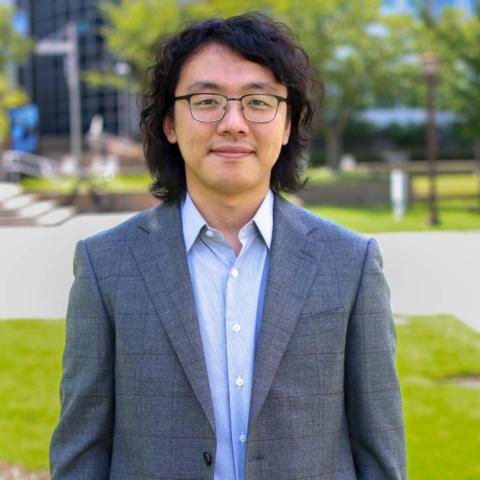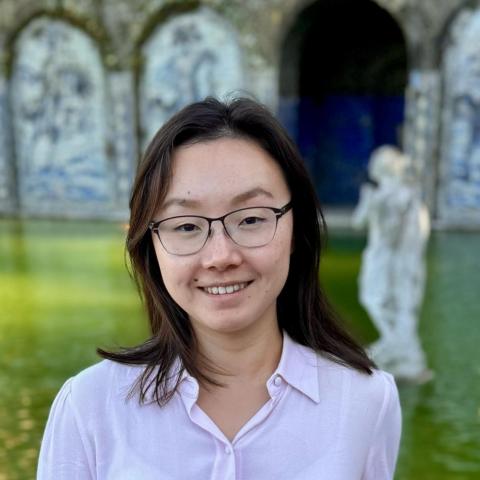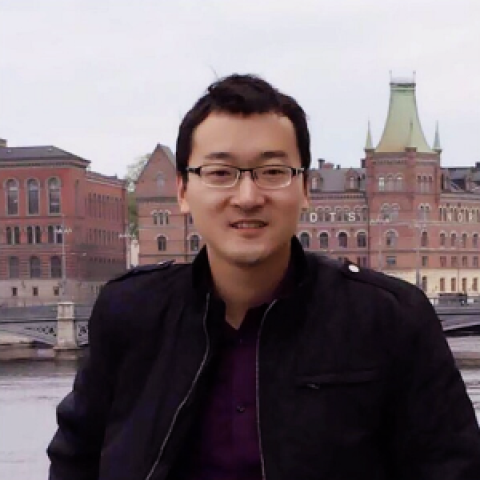
Ferdous Alam

Ferdous Alam
ferdous@gatech.edu

Dr. Alam joined the George W. Woodruff School of Mechanical Engineering as an assistant professor in January 2026. His primary research interests include efficient algorithms and methods for AI-native engineering applications. His group, Inference Lab, focuses on foundational AI for engineering tasks, physics-integrated AI, and robot learning for unstructured manufacturing tasks. Before joining Georgia Tech, he was a postdoctoral associate at MIT. Dr. Alam has received several national and international awards including Google research scholar awards in Applied science in 2024, Ford Best Paper award at IDECTC 2025, SEIKM Best paper award at IDETC 2025, Best paper award at MSEC 2020.

Assistant Professor
Additional Research
  • AI and Informatics
  • Automation
  • CAE and Design
  • Manufacturing
  • Robotics and Control
IRI/Group and Role
Robotics > Core Faculty
University, College, and School/Department
Georgia Institute of Technology > College of Engineering
Research Areas
Robotics
  • Foundations of Robotics

Tony G. Chen

Tony G. Chen is an Assistant Professor at Georgia Tech
tonygchen@gatech.edu

Tony G. Chen is an Assistant Professor at Georgia Tech. His research focuses on designing mechanical intelligent mechanisms for various robotics applications. Mechanical intelligence focuses on developing mechanisms and robotic platforms that make challenges for perception, control, and autonomy easier or more robust for natural, unstructured, and often unpredictable environments by virtue of their physical designs. To achieve this design approach, two main and common methods are often deployed: rapid prototyping and bio-inspiration. Chen is especially interested in three major research application areas: (i) field robotics where designing new robotic mobility platforms or equipping existing platforms with capabilities of manipulation, (ii) manipulation tasks in home and industrial environments, and (iii) biomimetic robotics for biological study.

Assistant Professor
Office
Callaway 438
IRI/Group and Role
Robotics > Core Faculty
University, College, and School/Department
Georgia Institute of Technology > College of Engineering > Woodruff School of Mechanical Engineering
Research Areas
Robotics
  • Manipulation and Locomotion

Patrick Danahy

Patrick Danahy is an Assistant Professor of Architecture at the Georgia Institute of Technology.
patrick.danahy@design.gatech.edu

Patrick Danahy is an Assistant Professor of Architecture at the Georgia Institute of Technology.

Previously, he has held positions as the Emerging Scholar in Design at the University of Texas at Austin, the Design Innovation Fellow at Ball State University and a Lecturer at the University of Pennsylvania. Patrick holds a Bachelor of Arts in Architecture from Clemson University, and a Master of Architecture from the University of Pennsylvania, where he received the Kanter-Tritsch Prize in Energy and Architectural Innovation, the Paul Cret T-Square Fellowship, the Van Alen Traveling Fellowship, the Dales Fellowship, the Kohn Fellowship, the Schenk-Woodman Merit Award and upon graduating was awarded the Arthur Spayd Brooke Memorial Silver Medal.

In 2022, he was selected as the distinguished professor of an Advanced Design Studio at Texas A&M University, where he received the ‘Best Design Studio’ award for that year. He has taught workshops on emerging media and digital technologies including at the 2022 ACADIA conference, the UCL Bartlett RC20 Skills-Share program, the University of Kentucky, the University of Texas at Austin, Texas A&M University, the University of Michigan and the University of Pennsylvania. His teaching focuses on computation and robotics, integrating architectural reference with emerging machine-learning technologies.

Patrick's research has been presented in international conferences including Digital Futures Young, ACADIA, ICRA, TRAITS Post Digital Neobaroque, SIGRADI and CAADRIA, where his team received the award for best presentation runner up. His work has been exhibited internationally at the Venice Biennale, the ENVD Gallery at the University of Colorado Boulder, at the Month of Modern, and in galleries at the Pratt Institute, Ball State University, the University of Texas and the University of Pennsylvania.

Assistant Professor, School of Architecture
Additional Research
  • Computation and robotics
  • Integrating architectural reference with emerging machine-learning technologies.
IRI/Group and Role
Robotics > Core Faculty
University, College, and School/Department
Georgia Institute of Technology > College of Design > School of Architecture
Research Areas
Robotics
  • Field and Service Robotics
  • Human-Centered Robotics

Yashwanth Kumar Nakka

Photo of Yashwanth Kumar Nakka
ynakka3@gatech.edu

Yashwanth Nakka is the director of the Aerospace Robotics Laboratory at Georgia Tech. His research interests broadly include designing aerospace autonomous systems, spacecraft autonomy, planning (guidance) under uncertainty, and nonlinear dynamics and control. Earlier, he was a Robotics Technologist (2021-2024) at NASA Jet Propulsion Laboratory, where he led the research and development planning, controls, and estimation tasks on CADRE, EELS, and DARPA LINC. He received a B. Tech. in aerospace engineering from the Indian Institute of Space Science and Technology, India, in 2011, an M. Sc. degree in aerospace engineering from the University of Illinois Urbana-Champaign, IL, USA, in 2016, and an M. Sc. degree and a Ph.D. in space engineering from California Institute of Technology, CA, USA, in 2017, and 2021, respectively. He was an engineer for the GSAT-15 and 16 missions at the Indian Space Research Organization from 2011 to 2014. He received the JPL CADRE Team Award for his work on multi-agent autonomy. He won the best student paper award at the 2021 American Institute of Aeronautics and Astronautics Guidance, Navigation, and Controls conference and the best paper award at the 11th International Workshop on Satellite Constellations and Formation Flying.
 

Education

  • Ph.D. in Space Engineering - California Institute of Technology 2017 - 2021
  • M.S. in Space Engineering - California Institute of Technology 2016-2017
  • M.S. in Aerospace Engineering - University of Illinois Urbana-Champaign 2014-2016
  • B.Tech in Aerospace Engineering - Indian Institute of Space Science Technology 2007 - 2011

Distinctions & Awards

  • NASA Jet Propulsion Laboratory CADRE Team Award, 2024
  • Best Student Paper Award at AIAA Guidance, Navigation and Control Conference, 2021
  • David and Catherine Thompson Graduate Fellowship Fund for Space, 2020
  • Best Paper Award at 11th International Workshop on Satellite Constellations and Formation Flying, 2019
  • Keck Institute of Space Studies Affiliate, 2019
  • Excellent Reviewer Nomination, Journal of Guidance Control and Dynamics, 2018
  • Darryl G. Greenmayer Fellowship Recipient, 2016
  • Outstanding Performance Award, Indian Space Research Organization (ISRO), 2012 and 2013
  • Indian Space Research Organisation (ISRO) Scholarship Recipient, 2007 - 2011
Assistant Professor, Daniel Guggenheim School of Aerospace Engineering
Office
ESM Building 205
IRI/Group and Role
Space > Faculty
Robotics > Core Faculty
University, College, and School/Department
Georgia Institute of Technology > College of Engineering > Guggenheim School of Aerospace Engineering
Research Areas
Space
Robotics
  • Field and Service Robotics

Mohsen Moghaddam

Mohsen Moghaddam's profile picture
mohsen.moghaddam@gatech.edu

Mohsen Moghaddam is the Gary C. Butler Family Associate Professor in the H. Milton Stewart School of Industrial and Systems Engineering and the George W. Woodruff School of Mechanical Engineering at the Georgia Institute of Technology. He directs the Symbiotic and Augmented Intelligence Lab (SAIL), where his research focuses on developing human-centered computational models, algorithms, and tools at the intersection of AI and spatial computing to enhance learning and creativity in various cognitive and psychomotor tasks within industrial settings. Previously, Dr. Moghaddam was an Assistant Professor in the Department of Mechanical and Industrial Engineering and an Affiliated Faculty with the Khoury College of Computer Sciences at Northeastern University in Boston. He has also served as a Visiting Professor with the HumanTech project at Politecnico di Milano and as a Visiting Scholar at the Next Level Lab, Harvard University. Dr. Moghaddam earned his PhD in Industrial Engineering from Purdue University and completed a Postdoctoral Associate position at the GE-Purdue Partnership in Research and Innovation in Advanced Manufacturing. His research has been supported by the U.S. National Science Foundation, the U.S. Defense Advanced Research Projects Agency, the U.S. Navy, and industry partners.

Gary C. Butler Family Associate Professor
Office
Groseclose 318
Additional Research
  • Extended Reality
  • Human-Robot Interaction
IRI/Group and Role
Robotics > Core Faculty
University, College, and School/Department
Georgia Institute of Technology > College of Engineering > School of Industrial Systems Engineering
Georgia Institute of Technology > College of Engineering > Woodruff School of Mechanical Engineering
Research Areas
Robotics
  • Manipulation and Locomotion
  • Human-Centered Robotics
  • Safe, Secure, and Resilient Autonomy
  • Sensing and Perception

Edvard P.G. Bruun

Assistant Professor Edvard P.G. Bruun
edvard.bruun@ce.gatech.edu

Dr. Edvard Bruun joined the faculty in the School of Civil and Environmental Engineering at the Georgia Institute of Technology in August 2024. He completed his Ph.D. (2024) in Civil and Environmental Engineering at Princeton University. Dr. Bruun is also a licensed professional engineer in Canada and worked as a structural engineer at Arup before pursuing his Ph.D.

Dr. Bruun’s research centers on robotic automation for the assembly and disassembly of large-scale building components. He develops computational methods to design geometrically complex yet material-efficient structures that demand robotic fabrication for their construction. By harnessing the spatial precision and multifunctionality of cooperative multi-robot systems, Dr. Bruun coordinates multiple industrial robotic arms to execute intricate tasks. These include providing temporary structural support and facilitating the addition, removal, or repurposing of building components in collaboration with human operators.

Assistant Professor
Phone
647.241.3198
Office
Mason 3140A
Additional Research
  • Cooperative Robotic Fabrication
  • Construction Automation
  • Pre-Fabrication
  • Scaffold-Free (Dis)Assembly
IRI/Group and Role
Robotics > Core Faculty
University, College, and School/Department
Georgia Institute of Technology > College of Engineering > School of Civil and Environmental Engineering
Research Areas
Robotics
  • Human-Centered Robotics
  • Safe, Secure, and Resilient Autonomy
  • Sensing and Perception

Sean Wilson

Sean Wilson, Collaborative Autonomy Branch Chief / Director of the Robotarium Lab
sean.wilson@gtri.gatech.edu

Sean Wilson is a Senior Research Engineer serving as the Collaborative Autonomy Branch Chief for the Aerospace, Transportation & Advanced Systems Laboratory at the Georgia Tech Research Institute (GTRI). Additionally, he serves as the Director of the Robotarium Lab (https://www.robotarium.gatech.edu/) at Georgia Tech, which enables people around the world to deploy robotic algorithms onto robotic hardware free of charge.

He received M.S. and Ph.D. degrees in mechanical engineering from Arizona State University in 2017 and a B.A. degree in physics and mathematics from the State University of New York at Geneseo in 2012. He previously served as a postdoctoral fellow at the Georgia Institute of Technology.

Dr. Wilson’s research interests include remotely-accessible robotic hardware, collaborative autonomy, as well as the control of multi-agent and swarm robotic systems. 

Senior Research Engineer
Collaborative Autonomy Branch Chief / Director of the Robotarium Lab
Office
CCRF B11-3133D
Additional Research
  • Swarm Robotics
  • Distributed Control
  • Multi-Robot Systems Collective Behaviors
  • Bio-Inspired Robotics
IRI/Group and Role
Robotics > Core Faculty
University, College, and School/Department
Georgia Institute of Technology > College of Engineering > School of Electrical and Computer Engineering
GTRI
Geogia Tech Research Institute > Aerospace, Transportation & Advanced Systems Laboratory
Research Areas
Robotics
  • Field and Service Robotics
  • Foundations of Robotics
  • Manipulation and Locomotion
  • Safe, Secure, and Resilient Autonomy

Sarah H.Q. Li

Sarah H.Q. Li - Assistant Professor; Aerospace Engineering
sarahli@gatech.edu

Sarah Li will join the Daniel Guggenheim School of Aerospace Engineering in January 2025. Her research advances multi-agent models and algorithms to overcome challenges facing future air and space mobility systems. Her research lies at the intersection of game theory, stochastic control, and optimization to enable optimal and safe decision-making of autonomous systems in interactive settings. Sarah earned her Ph.D. in Aeronautics and Astronautics from the University of Washington and her B.A.Sc. in Engineering Physics from the University of British Columbia. She is currently a postdoctoral scholar at ETH Zurich in Information Technology and Electrical Engineering. She was a 2020 Zonta International Amelia Earhart Fellow and a 2022 University of Washington Condit Graduate Fellow. During her Ph.D., she interned with Microsoft Research to develop supply chain games and Loon to develop multi-disciplinary design optimization for stratospheric balloons.

Assistant Professor
Additional Research
  • Cyber-physical Systems
  • Game theory
  • Multi-agent Interactions
IRI/Group and Role
Robotics > Core Faculty
University, College, and School/Department
Georgia Institute of Technology > College of Engineering > Guggenheim School of Aerospace Engineering
Research Areas
Robotics
  • Safe, Secure, and Resilient Autonomy
  • Foundations of Robotics

Matthew T. Flavin

Matthew T. Flavin; ECE
mflavin@gatech.edu

Prof. Matthew Flavin is an assistant professor in the School of Electrical and Computer Engineering at the Georgia Institute of Technology where he leads the Flavin Neuromachines Lab. Before joining the faculty at Georgia Tech, he was a postdoctoral researcher at Northwestern University. He received his M.S. and Ph.D. degrees in Electrical Engineering in 2017 and 2021 from the Massachusetts Institute of Technology (MIT), and he received his B.S. in Electrical Engineering in 2015 from the University of Illinois at Urbana-Champaign (UIUC). He received the NIH Ruth L. Kirschstein Institutional National Research Service Award (T32) and the Draper Laboratory Fellowship. The vision for his independent research program is to develop powerful peripheral neural interfaces and mechatronic wearables that leverage advanced sensors and intelligent systems to address important and unresolved challenges in patient care.

Assistant Professor
Office
Van Leer 325A
Additional Research
  • Bioengineering
  • Biotechnology
  • Communications
  • Computer Engineering
  • Cyber Technology
  • Cyber-Physical Systems
  • Drug Design, Development and Delivery
  • Electronic Materials
  • Energy Harvesting
  • Flexible Electronics
  • Healthcare
  • Human Augmentation
  • Human-Centered Robotics
  • IoT for Manufacturing
  • IoT/Machine-to-Machine Trust
  • Lifelong Health and Well-Being
  • Locomotion & Manipulation
  • Machine Learning
  • Medical Device Design, Development and Delivery
  • Micro and Nano Device Engineering
  • Miniaturization & Integration
  • Mobile & Wireless Communications
  • Neuroscience
  • Precision Machining
  • Regenerative Medicine
  • Robotics
  • Soft Robotics
IRI/Group and Role
Robotics > Core Faculty
Bioengineering and Bioscience > Faculty
University, College, and School/Department
Georgia Institute of Technology > College of Engineering > School of Electrical and Computer Engineering
Research Areas
Robotics
  • Human-Centered Robotics

Ye Zhao

Ye Zhao's profile picture
ye.zhao@me.gatech.edu

Dr. Ye Zhao started as an Assistant Professor at the George W. Woodruff School of Mechanical Engineering in January 2019. Previously he was a Postdoctoral Fellow at Harvard University and obtained his Ph.D. from UT Austin, where he worked on robust motion planning and decision-making for robot manipulation and locomotion problems with frictional contact behaviors. At Georgia Tech, he directs the Laboratory for Intelligent Decision and Autonomous Robots. His research interests lie broadly in planning, control, decision-making, and learning algorithms of highly agile, contact-rich, and human-cooperative robots. Dr. Zhao is especially interested in computationally efficient optimization algorithms and formal methods for challenging robotics problems with formal guarantees on robustness, safety, autonomy, and real-time performance. The LIDAR group aims at pushing the boundary of robot autonomy, intelligent decision, robust motion planning, and symbolic planning. The long-term goal is to devise theoretical and algorithmic underpinnings for collaborative humanoid and mobile robots operating in unstructured and unpredictable environments while working alongside humans. Robotic applications primarily focus on agile bipedal and quadrupedal locomotion, manipulation, heterogeneous robot teaming, and mobile platforms for extreme environment maneuvering.

Assistant Professor; School of Mechanical Engineering
Phone
404.894.3061
Office
GTMI 437
Additional Research

Robotics; Formal Methods; Optimization; Robust Motion Planning; Control

IRI/Group and Role
Robotics > Core Faculty
Robotics
University, College, and School/Department
Georgia Institute of Technology > College of Engineering > Woodruff School of Mechanical Engineering
Research Areas
Artificial Intelligence
Subscribe to Core Faculty