Matthew Swarts
Faith Sumpter (she/her/hers) joins the IPaT team as the program and operations manager. Faith joins the team from Georgia Tech’s Institute Diversity department where she provided support for several programs including Employee Resource Groups, Inclusive Leaders Academy, and Transformative Narratives. Prior to that position, she worked within student activities, orientation, and leadership programs at UNC Asheville, Chattahoochee Technical College, and Agnes Scott College. Faith received a bachelor of arts in Spanish from Wesleyan College in Macon, Georgia, and a master of arts in higher education and student affairs from the University of Connecticut in Storrs, CT. Outside of work, she is an active member of her community and serves as the member-at-large for diversity and inclusion for the Wesleyan College Alumnae Association Board of Managers.
Information Visualization; Visual Analytics; HCI
Richard Starr is a senior research scientist responsible for the IPaT Secure Data Enclave (IPaT SDE) (formerly the Protected Health Data infrastructure at IPaT). He develops and manages a common infrastructure to work with healthcare data. This secure environment can be employed across campus to house research data to maintain compliance with HIPAA, IRB, and partnership agreements.
Healthcare data; data science
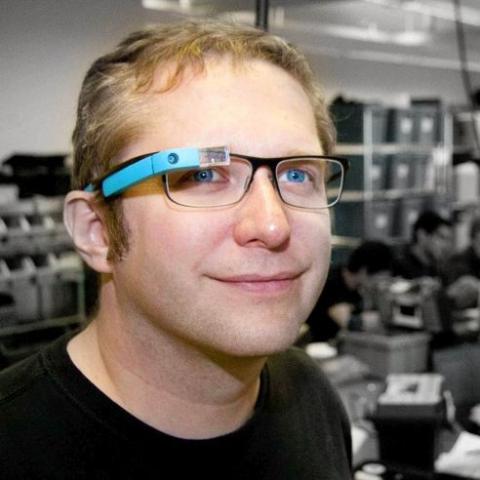
Thad Starner is a Professor at the Georgia Institute of Technology's School of Interactive Computing. Thad was perhaps the first to integrate a wearable computer into his everyday life as an intelligent personal assistant. Starner's work as a Ph.D. student would help found the field of Wearable Computing. His group's prototypes and patents on mobile MP3 players, mobile instant messaging and e-mail, gesture-based interfaces, and mobile context-based search foreshadowed now commonplace devices and services. Thad has authored over 100 scientific publications with over 100 co-authors on mobile Human Computer Interaction (HCI), pattern discovery, human power generation for mobile devices, and gesture recognition, and he is a founder and current co-chair of the IEEE Technical Committee on Wearable Information Systems. His work is discussed in public forums such as CNN, NPR, the BBC, CBS's 60 Minutes, The New York Times, Nikkei Science, The London Independent, The Bangkok Post, and The Wall Street Journal.
Wearable Computing; Artificial Intelligence; Augmented Reality; Human Computer Interaction; Ubiquitous Computing
Stephen Sprigle is a Professor at the Georgia Institute of Technology with appointments in Bioengineering, Industrial Design and the George W. Woodruff School of Mechanical Engineering.
A biomedical engineer with a license in physical therapy, Sprigle directs the Rehabilitation Engineering and Applied Research Lab (REARLab), which focuses on applied disability research and development. The REARLab’s research interests include the biomechanics of wheelchair seating and posture, pressure ulcer prevention, and manual wheelchair propulsion. Its development activities include standardized wheelchair and cushion testing and the design of assistive and diagnostic technologies. Sprigle teaches design-related classes in both the Schools of Industrial Design and Mechanical Engineering.
Dr. Sitterle is a Principal Research Engineer at the Georgia Tech Research Institute (GTRI), where her technical work synthesizes systems science, complex systems, and defense analysis. She is an expert with over 20 years of experience in engineering science, integrating engineering, natural, and physical sciences leading to the design and analysis of systems. Her primary areas of focus are identifying driving influences in support of materiel development under uncertainty, and integrating defense operational needs with systems sciences across multiple domains to supports design and assessment of defense systems and operational and tactical concepts of employment in theater environments. Dr. Sitterle also serves as the Chief Scientist for the Systems Engineering Research Division within the Electronic Systems Laboratory in GTRI. In this role, she supports the definition and execution of R&D across the main pillars of model-based approaches, human systems, and digital transformation of systems engineering to provide new capabilities and advance stakeholders’ decision-making processes. She also serves as a current member of the Research Council for the Systems Engineering Research Center (SERC), a DoD UARC led by Stevens Institute of Technology.
Nicoleta Serban is the Peterson Professor of Pediatric Research in the H. Milton Stewart School of Industrial and Systems Engineering at Georgia Tech.
Dr. Serban's most recent research focuses on model-based data mining for functional data, spatio-temporal data with applications to industrial economics with a focus on service distribution and nonparametric statistical methods motivated by recent applications from proteomics and genomics.
She received her B.S. in Mathematics and an M.S. in Theoretical Statistics and Stochastic Processes from the University of Bucharest. She went on to earn her Ph.D. in Statistics at Carnegie Mellon University.
Dr. Serban's research interests on Health Analytics span various dimensions including large-scale data representation with a focus on processing patient-level health information into data features dictated by various considerations, such as data-generation process and data sparsity; machine learning and statistical modeling to acquire knowledge from a compilation of health-related datasets with a focus on geographic and temporal variations; and integration of statistical estIMaTes into informed decision making in healthcare delivery and into managing the complexity of the healthcare system.