Mary Ann Weitnauer
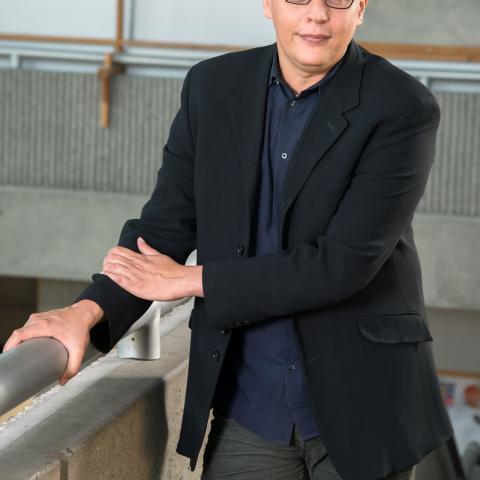
Gil Weinberg is a professor and the founding director of Georgia Tech Center for Music Technology, where he leads the Robotic Musicianship group. His research focuses on developing artificial creativity and musical expression for robots and augmented humans. Among his projects are a marimba playing robotic musician called Shimon that uses machine learning for Jazz improvisation, and a prosthetic robotic arm for amputees that restores and enhances human drumming abilities. Weinberg presented his work worldwide in venues such as The Kennedy Center, The World Economic Forum, Ars Electronica, Smithsonian Cooper-Hewitt Museum, SIGGRAPH, TED-Ed, DLD and others. His music was performed with Orchestras such as Deutsches Symphonie-Orchester Berlin, the National Irish Symphony Orchestra, and the Scottish BBC Symphony while his research has been disseminated through numerous journal articles and patents. Dr. Weinberg received his MS and Ph.D. degrees in Media Arts and Sciences from MIT and his BA from the interdisciplinary program for fostering excellence in Tel Aviv University.
Music Technology; Computer Music; Robotics; Developing Artificial Creativity and Musical Expression for Robots and Augmented Humans
May Dongmei Wang, Ph.D., is The Wallace H Coulter Distinguished Faculty Fellow, professor of BME, ECE and CSE, Director of Biomedical Big Data Initiative, and Georgia Distinguished Cancer Scholar. She is also Petit Institute Faculty Fellow, Kavli Fellow, Fellow of AIMBE, Fellow of IEEE, and Fellow of IAMBE. She received BEng from Tsinghua University China and MS/PhD from Georgia Institute of Technology (GIT). Dr. Wang’s research and teaching are in Biomedical Big Data and AI-Driven Biomedical Health Informatics and Intelligent Reality (IR) for predictive, personalized, and precision health. She has published over 270 referred journal and conference proceeding articles (13,500+ GS-Citations) and delivered over 280 invited and keynote lectures. Dr. Wang’s research has been supported by NIH, NSF, CDC, GRA, GCC, VA, Children’s Healthcare of Atlanta, Enduring Heart Foundation, Wallace Coulter Foundation, Carol Ann and David Flanagan Foundation, Shriner’s Hospitals, Microsoft Research, HP, UCB, and Amazon.
Dr. Wang chairs IEEE Engineering in Medicine and Biology Society (EMBS) BHI-Technical Community and ACM Special Interest Group in Bioinformatics (SIGBio), and is the Senior Editor of IEEE Journal of Biomedical & Health Informatics (IF=7.02), and Associate Editor for IEEE Transactions on BME, and IEEE Review of BME. She was IEEE EMBS Distinguished Lecturer and PNAS (Proceeding of National Academy of Sciences) Emerging Area Editor. During the past decade, Dr. Wang has been a standing panelist for NIH Study Sections, NSF Smart and Connect Health, and Brain Canada, and has co-chaired and helped organize more than 10 conferences by IEEE Engineering in Medicine and Biologics Gordon Research Conferences, ACM Special Interest Groups in Bioinformatics, and IEEE Future Directions.
Dr. Wang received GIT Outstanding Faculty Mentor for Undergrad Research Award and Emory University MilliPub Award for a high-impact paper cited over 1,000 times. She was selected into 2022 Georgia Tech LeadingWomen Program and 2021 Georgia Tech Provost Emerging Leaders Program. Previously, she was Carol Ann and David Flanagan Distinguished Faculty Fellow, GIT Biomedical Informatics Program Co-Director in ACTSI, and Bioinformatics and Biocomputing Core Director in NIH/NCI-Sponsored U54 Center for Cancer Nanotechnology Excellence.
Tim began working as the GVU Center’s research technologist in 2018. In conjunction with IPaT, he developed, designed, and launched the Craft Lab in 2022 and is serving as the director of the Prototyping, Craft, and Usability labs. Tim provides strategic oversight of the tools and technologies present in these “innovation labs” and seeks opportunities to grow and shape the spaces to match the ever-changing research landscape. These spaces are an essential component of the research within IPaT and the broader Georgia Tech community. Tim views the spaces not only as a set of technologies like 3D printers, laser cutters, embroidery machines, etc., but also as a catalyst to bring together community members and explore new frontiers of research.
Tim has also spent much of his time at Georgia Tech working in research computing, including his roles as a Research Technologist in College of Computing’s Technology Services Organization (TSO) and as a part of IPaT’s Research Operations team. He served as interim Associate Director for Research in TSO in 2023. His focus in these areas is in DevOps and business automation with aims to match IT capabilities and capacities with the needs of end-users.
Tim holds a master of science in human-computer interaction and a graduate certificate in Management of Technology from Georgia Tech. His thesis project focused on the introductory experience to academic makerspaces and digital tools that support new users. In this work, Tim prototyped a new digital training aid for makerspaces to allow more seamless introduction for new users while satisfying training requirements.
Peter Swire, J.D., is Associate Director of Policy for the Institute for Information Security & Privacy. Swire has been a privacy and cyberlaw scholar, government leader, and practitioner since the rise of the Internet in the 1990's. In 2013, he became the Nancy J. and Lawrence P. Huang Professor of Law and Ethics at the Georgia institute of Technology. Swire teaches in the Scheller College of Business, with appointments by courtesy with the College of Computing and School of Public Policy. He is senior counsel with the law firm of Alston & Bird LLP. Swire served as one of five members of President Obama's Review Group on Intelligence and Communications Technology. Prior to that, he was co-chair of the global Do Not Track process for the World Wide Web Consortium. He is a senior fellow with the Future of Privacy Forum, and a policy fellow with the Center for Democracy and Technology. Under President Clinton, Swire was the chief counselor for privacy in the U.S. Office of Management and Budget -- the only person to date to have U.S. government-wide responsibility for privacy policy. In that role, his activities included being White House coordinator for the HIPAA medical privacy rule, chairing a White House task force on how to update wiretap laws for the Internet age, and helping negotiate the U.S.-E.U. Safe Harbor agreement for trans-border data flows.Under President Obama, he was special assistant to the President for economic policy. Swire is author of five books and numerous scholarly papers. He has testified often before the Congress, and been quoted regularly in the press. He has served on privacy and security advisory boards for companies including Google, IBM, Intel, and Microsoft, as well as a number of start-ups. Swire graduated from Princeton University, summa cum laude, and the Yale Law School, where he was an editor of the Yale Law Journal.