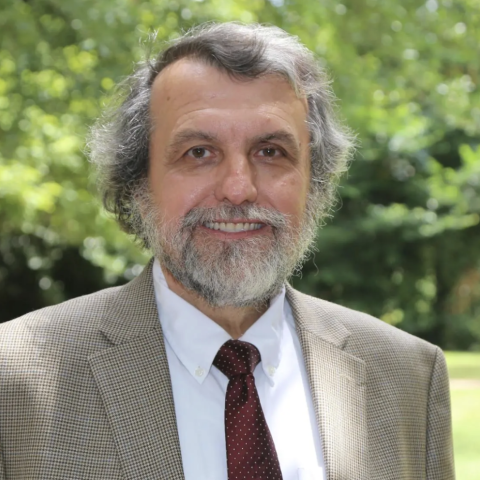
Armistead Russell
Climate/Environment
- Energy Economics, Policy, and Public Health
- Carbon Capture, Utilization and Storage
- Energy Systems, Grid Resilience, and Cybersecurity
Climate/Environment
Separations Technology; Biofuels; Energy & Water; Separation Technologies
Bo Rotoloni is a research engineer and executive leader at the forefront of today's toughest cybersecurity challenges. He serves as Director of Research at Georgia Tech Research Institute (GTRI) and as Director of the Information & Cyber Sciences Directorate (ICSD). Through these roles, he oversees a constellation of labs and units involving more than 500 people, $120 million in annual awards, and combined operating budgets of more than $11.5 million in order to achieve the operational vision, mission, goals and objectives for cybersecurity solutions by Georgia Tech. These roles have provided Rotoloni with extensive technical, financial, and managerial experience in government and industry. The combination of research, education, operations, and financial experience are unique in the cyber and information systems fields and Rotoloni frequently is called upon to deliver briefings to high-level, leading government officials and industry executives. The government is placing considerable attention on defending the nation against cyber warfare, with the explosion of both offensive and defensive cyber-related activity which also threaten private industry," Rotoloni said. "Our multi-faceted, comprehensive research structure at Georgia Tech allows us to actively meet urgent needs." Prior to joining GTRI, Rotoloni served as the director of Wavesplitter Technologies' rapid prototyping and engineering R&D center, where he was responsible for the operation and commissioning of a pilot manufacturing, rapid prototyping and R&D center within the passive and active optical components industry. In that role, Rotoloni was responsible for all facets of the operation including financials, production, support, operations and engineering. Prior to joining Wavesplitter Technologies, Rotoloni served as a Technical Manager at Lucent Technologies, responsible for the operation and development of ultra-high speed manufacturing processes within the manufacture of optical fiber for transmission. Specifically, Rotoloni was the lead engineer in the design and development of software and hardware for inline testing and coloring of optical fiber, which is still in use today. Rotoloni holds an M.S. in Electrical Engineering and a B.S. in Mechanical Engineering, both from Clemson University.
Communication Systems; Defense / National Security; Modeling & Simulation
Ajeet Rohatgi received the B.S. (E.E.) degree from Indian Institute of Technology in 1971, the M.S. (Materials Engineering) from Virginia Polytechnic Institute and State University in 1973, and the Ph.D. in Metallurgy and Materials Science from Lehigh University in 1977. He joined the Westinghouse Research and Development Center in Pittsburgh, Pennsylvania in 1977 and became a Westinghouse Fellow while working on the science and technology of photovoltaic and microelectronic devices. Rohatgi joined the ECE faculty at Georgia Tech in 1985 and started a program on photovoltaics, which has become one of the best in the country. He has become an internationally recognized leader in photovoltaics. He is the founding director of the first university-based DOE Center of Excellence in Photovoltaic Research and Education. He is the author of more than 300 publications and holds 10 U.S. patents. Rohatgi has received numerous awards and distinctions from professional societies and Georgia Tech. He is the founder and CTO for Suniva.
silicon devices; solar cells; dielectrics; Compund Semiconductors; solar energy
Climate/Environment; Electric Vehicles; Smart Infrastructure
Rusty Roberts is the Director of the Aerospace, Transportation and Advanced Systems (ATAS) Laboratory at the Georgia Tech Research Institute (GTRI). ATAS develops advanced systems concepts, builds system prototypes, and performs research on technologies related to aerospace, transportation, power and energy, threat systems, and food processing. A nationally recognized expert in test and evaluation, Roberts has held the position of the President of the International Test and Evaluation Association (ITEA). He also started and presently leads a GTRI-wide test and evaluation initiative that brought together the resources to provide Science & Technology support to the Office of the Secretary of Defense Test Resource Management Center. Mr. Roberts has also worked with U.S. government officials to establish key requirements for the testing of U.S. electronic countermeasures against surface-to-air missile threats and has been able to provide solutions developed by GTRI. Solutions included the threat replica of a medium range surface-to-air missile (SAM) acquisition radar for the U.S. Army and the Advanced Airborne Interceptor Simulator (AAIS) for the U.S. Air Force. He also led the efforts that developed the Missle-on-a-Mountain program at the Electronic Combat Range in China Lake, California. This one-of-a-kind simulation facility has been called a key national asset in testing electronic countermeasures against surface-to-air missle systems. The facility is in high demand by the U.S. Navy, U.S. Air Force, and allied air forces. Prior to joining GTRI, Mr. Roberts served as an active duty U.S. Army Signal Corps officer for ten years, with assignments at Fort Gordon, GA and Kaiserslautern, Germany. His last assignment was at the U.S. Military Academy at West Point as an Assistant Professor in the Department of Electrical Engineering teaching Electronic Circuit Design. During his tour at West Point he became the Course Director for the Senior-level, two-semester electronics course for the Department. Mr. Roberts continued to serve in the Army Reserve after leaving Active Duty while at GTRI. Roberts holds a Bachelor of Science degree in Electrical Engineering from West Point, a Master of Science degree in Electrical Engineering from the Georgia Institute of Technology, and a Maste
Autonomy; Transportation; Smart Infrastructure
Electronics; Electrical Grid
Elsa Reichmanis is Anderson Chair in Chemical Engineering in the Department of Chemical and Biomolecular Engineering at Lehigh University. Prior to joining Lehigh, she was Professor and Pete Silas Chair in Chemical Engineering in the School of Chemical and Biomolecular Engineering at the Georgia Institute of Technology. She started her independent career at Bell Labs where she was Bell Labs Fellow and Director of the Materials Research Department. She received her PhD and BS degrees in chemistry from Syracuse University. Her research interests include the chemistry, properties, and application of materials technologies for photonic and electronic applications. She has had impact in the design of new imaging chemistries for advanced lithographic applications, and designed one of the first readily accessible and manufacturable polymers for advanced silicon device manufacturing using 193 nm lithography.
The Reichmanis research group is currently exploring polymeric and hybrid organic/inorganic materials chemistries for a range of device and electronic and sustainable energy applications. Her research, at the interface of chemical engineering, chemistry, materials science, optics, and electronics, spans from fundamental concept to technology development and implementation, with particular focus on polymeric and nanostructured materials for advanced technologies. Currently, efforts aim to identify fundamental parameters that will enable sub-nanometer scale dimensional control of organic, polymer and/or hybrid materials for applications including transistor devices, photovoltaics, and high-capacity energy storage.
Reichmanis was elected to the National Academy of Engineering in 1995 and has participated in several National Research Council (NRC) activities. She was an elected member of the Bureau of the International Union for Pure and Applied Chemistry (IUPAC); and has been active in the American Chemical Society throughout her career, having served as 2003 President of the Society. Elsa Reichmanis is the recipient of several awards, including the ACS Award in the Chemistry of Materials (2018), the ACS Award in Applied Polymer Science (1999), the ASM Engineering Materials Achievement Award (1996), and the Society of Chemical Industry’s Perkin Medal (2001). In other service, she is an Executive Editor of the ACS Journal Chemistry of Materials.
The Reichmanis Group works at the interface of chemical engineering, chemistry, materials science, optics, and electronics spanning the range from fundamental concept to technology development and implementation. Research interests include the chemistry, properties and applications of materials technologies for electronic and photonic applications, with particular focus on polymeric and nanostructured materials for advanced technologies. in paper-based battery applications as well.
Energy Storage; Solar; Biochemicals; Chemical Feedstocks; New Materials; Coatings & Barriers; Biorefining; Energy & Water; Biomaterials
Dr. Realff’s broad research interests are in the areas of process design, simulation, and scheduling. His current research is focused on the design and operation of processes that minimize waste production by recovery of useful products from waste streams, and the design of processes based on biomass inputs. In particular, he is interested in carbon capture processes both from flue gas and dilute capture from air as well as the analysis and design of processes that use biomass.
Biofuels; Carbon Capture; Separations Technology; System Design & Optimization; SMART Manufacturing; Energy & Water; Separation Technologies; Biochemicals; Chemical Feedstocks; Sugars; Lignin & Hemicellulose; Biofuels
W. Jud Ready is the executive director of the Space Research Institute. Prior to this role, he served as associate director of external engagement for the Georgia Tech Institute for Matter and Systems and director of the Georgia Tech Center for Space Technology and Research. He has also been an adjunct professor in the School of Materials Science and Engineering at Georgia Tech and a principal research engineer on the research faculty of Georgia Tech Research Institute (GTRI) for over a dozen years. Prior to joining the Georgia Tech faculty, he worked for a major military contractor (General Dynamics) as well as in small business (MicroCoating Technologies). He has served as PI or co-PI for grants totaling ~$17M awarded by the Army, Navy, Air Force, DARPA, NASA, NSF, NIST, industry, charitable foundations and the States of Georgia and Florida. His current research focuses primarily on energy, aerospace, nanomaterial applications, and electronics reliability.
Materials Failure and Reliability; Carbon Nanotubes; Integrated photonics; Photovoltaics; Solar