Thomas Collins
Autonomy
Autonomy
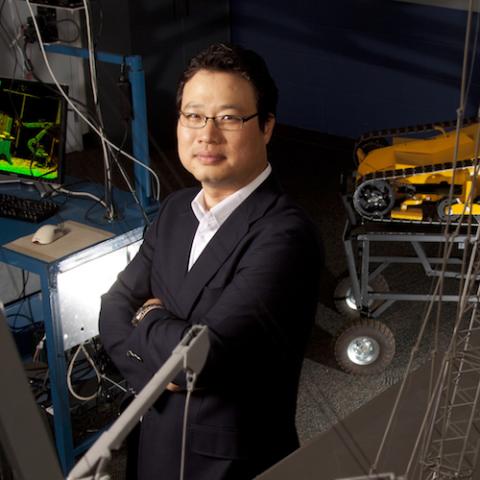
Dr. Yong Cho, MSCE '97, has returned to CEE as an associate professor. Cho comes to Georgia Tech most recently from the University of Nebraska-Lincoln, and the University of Wisconsin-Platteville, where he taught construction engineering, construction management, and architectural engineering after earning his doctorate at the University of Texas in 2000. A 2011 recipient of the NSF Early Career Award, his research interests include construction automation, robotics, and transportation. He is leading the development of a new paradigm in these research areas by challenging the current understanding of science/engineering technologies in construction and sustainable built environments. Among the challenges he is investigating are robotizing several critical construction and maintenance tasks and disaster relief efforts.
robotics in construction and disaster relief; UAV3D visualization; sensing for safety; indoor position tracking
Yue Chen is an assistant professor in the Department of Biomedical Engineering, GT/Emory. He received his Ph.D. degree in Mechanical Engineering from Vanderbilt University, M.S. in Mechanical Engineering from Hong Kong Polytechnic University, and a B.S. in Vehicle Engineering from Hunan University. His research focused on designing, modeling, and control of continuum robots and apply them in medicine.
Yongxin Chen was born in Ganzhou, Jiangxi, China. He received his BSc in Mechanical Engineering from Shanghai Jiao Tong university, China, in 2011, and a Ph.D. degree in Mechanical Engineering, under the supervision of Tryphon Georgiou, from University of Minnesota in 2016. He is currently an Assistant Professor in the School of Aerospace Engineering at Georgia Institute of Technology. Before joining Georgia Tech, he had a one-year Research Fellowship in the Department of Medical Physics at Memorial Sloan Kettering Cancer Center with Allen Tannenbaum from 2016.8 to 2017.8 and was an Assistant Professor in the Department of Electrical and Computer Engineering at Iowa State University from 2017.8 to 2018.8. He received the George S. Axelby Best Paper Award (IEEE Transaction on Automatic Control) in 2017 for his joint work "Optimal steering of a linear stochastic system to a final probability distribution, Part I" with Tryphon Georgiou and Michele Pavon.
control theory; optimal mass transport; machine learning; robotics; optimization
Education
Masters of Science, Computer Science, Georgia Institute of Technology, 2022
Bachelors of Science, Mechanical Engineering, Georgia Institute of Technology, 2020
Research Expertise
Robot Planning and Control, Embodied Artificial Intelligence, Laboratory Automation, Software Engineering
Selected Publications
Bowles-Welch, A., Byrnes, W., Kanwar, B., Wang, B., Joffe, B., Casteleiro Costa, P., Armenta, M., Xu, J., Damen, N., Zhang, C., Mazumdar, A., Robles, F., Yeago, C., Roy, K., Balakirsky, S. (2021). Artificial Intelligence Enabled Biomanufacturing of Cell Therapies. Georgia Tech Research Institute Internal Research and Development (IRAD) Journal
Byrnes, W., Ahlin, K., Rains, G., & McMurray, G. (2019). Methodology for Stress Identification in Crop Fields Using 4D Height Data. IFAC-PapersOnLine, 52(30), 336–341. https://doi.org/10.1016/j.ifacol.2019.12.562
Byrnes, W., Kanwar, B., Damen, N., Wang, B., Bowles-Welch, A. C., Roy, K., & Balakirsky, S. (2023). Process Development and Manufacturing: A NEEDLE-BASED AUTOSAMPLER FOR BIOREACTOR CELL MEDIA COLLECTION. Cytotherapy, 25(6), S172.
Wang, B., Kanwar, B., Byrnes, W., Costa, P. C., Filan, C., Bowles-Welch, A. C., ... & Roy, K. (2023). Process Development and Manufacturing: DIGITAL TWIN-ENABLED FEEDBACK-CONTROLLED AUTOMATION WITH INTEGRATED PROCESS ANALYTICS FOR BIOMANUFACTURING OF CELL THERAPIES. Cytotherapy, 25(6), S206-S207.
Professional Activities
STEM@GTRI Program Mentor
IEEE Member
Autonomy
Autonomy
Dhruv Batra is an Associate Professor in the School of Interactive Computing at Georgia Tech. His research interests lie at the intersection of machine learning, computer vision, natural language processing, and AI, with a focus on developing intelligent systems that are able to concisely summarize their beliefs about the world with diverse predictions, integrate information and beliefs across different sub-components or `modules' of AI (vision, language, reasoning, dialog), and interpretable AI systems that provide explanations and justifications for why they believe what they believe. In past, he has also worked on topics such as interactive co-segmentation of large image collections, human body pose estIMaTion, action recognition, depth estIMaTion, and distributed optimization for inference and learning in probabilistic graphical models. He is a recipient of the Office of Naval Research (ONR) Young Investigator Program (YIP) award (2016), the National Science Foundation (NSF) CAREER award (2014), Army Research Office (ARO) Young Investigator Program (YIP) award (2014), Virginia Tech College of Engineering Outstanding New Assistant Professor award (2015), two Google Faculty Research Awards (2013, 2015), Amazon Academic Research award (2016), Carnegie Mellon Dean's Fellowship (2007), and several best paper awards (EMNLP 2017, ICML workshop on Visualization for Deep Learning 2016, ICCV workshop Object Understanding for Interaction 2016) and teaching commendations at Virginia Tech. His research is supported by NSF, ARO, ARL, ONR, DARPA, Amazon, Google, Microsoft, and NVIDIA. Research from his lab has been extensively covered in the media (with varying levels of accuracy) at CNN, BBC, CNBC, Bloomberg Business, The Boston Globe, MIT Technology Review, Newsweek, The Verge, New Scientist, and NPR. From 2013-2016, he was an Assistant Professor in the Bradley Department of Electrical and Computer Engineering at Virginia Tech, where he led the VT Machine Learning & Perception group and was a member of the Virginia Center for Autonomous Systems (VaCAS) and the VT Discovery Analytics Center (DAC). From 2010-2012, he was a Research Assistant Professor at Toyota Technological Institute at Chicago (TTIC), a philanthropically endowed academic computer science institute located on the University of Chicago campus. He received his M.S. and Ph.D. degrees from Carnegie Mellon University in 2007 and 2010 respectively, advised by Tsuhan Chen. In past, he has held visiting positions at the Machine Learning Department at CMU, CSAIL MIT, Microsoft Research, and Facebook AI Research.
Machine Learning; Computer Vision; Artificial Intelligence
Ronald C. Arkin received the B.S. Degree from the University of Michigan, the M.S. Degree from Stevens Institute of Technology, and a Ph.D. in Computer Science from the University of Massachusetts, Amherst in 1987. He then assumed the position of Assistant Professor in the College of Computing at the Georgia Institute of Technology where he now holds the rank of Regents' Professor and is the Director of the Mobile Robot Laboratory. He also serves as the Associate Dean for Research in the College of Computing at Georgia Tech since October 2008. During 1997-98, Professor Arkin served as STINT visiting Professor at the Centre for Autonomous Systems at the Royal Institute of Technology (KTH) in Stockholm, Sweden. From June-September 2005, Prof. Arkin held a Sabbatical Chair at the Sony Intelligence Dynamics Laboratory in Tokyo, Japan and then served as a member of the Robotics and Artificial Intelligence Group at LAAS/CNRS in Toulouse, France from October 2005-August 2006.
Artificial intelligence; Robotics; Robot ethic; Autonomous agents; Mobile Robots and Unmanned Vehicles; Multi-Agent Robotics; Machine Learning