Thad Starner

Thad Starner's profile picture
thad.starner@cc.gatech.edu

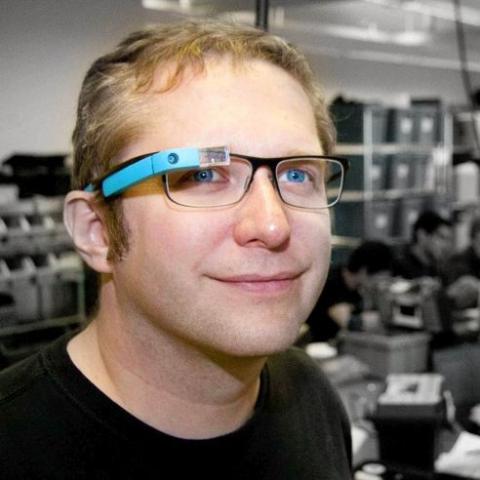
Thad Starner is a Professor at the Georgia Institute of Technology's School of Interactive Computing. Thad was perhaps the first to integrate a wearable computer into his everyday life as an intelligent personal assistant. Starner's work as a Ph.D. student would help found the field of Wearable Computing. His group's prototypes and patents on mobile MP3 players, mobile instant messaging and e-mail, gesture-based interfaces, and mobile context-based search foreshadowed now commonplace devices and services. Thad has authored over 100 scientific publications with over 100 co-authors on mobile Human Computer Interaction (HCI), pattern discovery, human power generation for mobile devices, and gesture recognition, and he is a founder and current co-chair of the IEEE Technical Committee on Wearable Information Systems. His work is discussed in public forums such as CNN, NPR, the BBC, CBS's 60 Minutes, The New York Times, Nikkei Science, The London Independent, The Bangkok Post, and The Wall Street Journal.

Professor; School of Interactive Computing
Additional Research

Wearable Computing; Artificial Intelligence; Augmented Reality; Human Computer Interaction; Ubiquitous Computing

IRI/Group and Role
People and Technology > Affiliated Faculty
Robotics > Affiliated Faculty
People and Technology
Robotics
University, College, and School/Department
Georgia Institute of Technology > College of Computing > School of Interactive Computing
Research Areas
Artificial Intelligence

Agata Rozga

Agata Rozga's profile picture
agata@gatech.edu

Agata Rozga is a psychologist with expertise and 13 years of experience forging a new interdisciplinary research area at the intersection of computing and psychology called computational behavioral science. The research vision is to transform the measurement, analysis, and understanding of health-related behaviors by leveraging advances in sensing, wearable and mobile technologies, and computational analysis methods. The ultimate goal is to develop tools that can lead to better detection, monitoring, and treatment of a variety of chronic health conditions.

One key area Dr. Rozga’s research has focused on is understanding early trajectories and predictors of social communication in children diagnosed with Autism Spectrum Disorder. In her most recent work, she is applying novel computational methods to longitudinal measures of communication behavior to understand different pathways to language in autism, including failure to acquire spoken language by age 5. Dr. Rozga’s research has recently expanded to include a focus on Mild Cognitive Impairment, with an eye toward developing novel AI-based systems to help monitor cognitive and functional decline in everyday activities, to deliver appropriate in-situ supports, and to support care networks.

Dr. Rozga serves as the Director of Translational Research for the Georgia Tech-led NSF National AI Institute for Collaborative Assistance and Responsive Interaction for Networked Groups (AI-CARING), and as the Programs and Research Director for the Technology Core of the Cognitive Empowerment Program at the Emory Brain-Health Center. She was previously the Head of Product for Diligent Robotics, https://www.diligentrobots.com/.

Research Scientist II
Phone
404-894-2304
Additional Research
  • Computational Behavioral Science
  • Health & Life Sciences
  • Machine Learning for Developmental Health
IRI/Group and Role
Data Engineering and Science > Faculty
People and Technology > Affiliated Faculty
Data Engineering and Science
People and Technology
University, College, and School/Department
Georgia Institute of Technology > College of Computing > School of Interactive Computing

Jessica Roberts

Jessica Roberts's profile picture
jessica.roberts@cc.gatech.edu

Jessica Roberts is an Assistant Professor in the School of Interactive Computing at GT with a PhD in the Learning Sciences, specializing in geospatial analysis and visualization in informal learning. As director of the Technology-Integrated Learning Environments (TILEs) Lab at Georgia Tech, her research explores technology-mediated social learning experiences in environments such as museums and citizen science. She is a former middle school teacher and a Brook Byers Institute for Sustainable Systems Faculty Fellow. Her work on the design of interactive learning technologies has been exhibited at venues such as the Field Museum of Natural History in Chicago and the New York Hall of Science. Prior to joining Georgia Tech, Dr. Roberts conducted postdoctoral research at the Human-Computer Interaction Institute at Carnegie Mellon University and the Tidal Lab at Northwestern University.

Associate Professor
Additional Research

Learning Sciences, geospatial analysis, visualization , theater design, museum exhibit design, citizen science, interactive technologies, interactive learning technologies

IRI/Group and Role
Sustainable Systems > Emeritus Fellows
University, College, and School/Department
Georgia Institute of Technology > College of Computing > School of Interactive Computing
Research Areas
Sustainable Systems
  • Sustainability Education Research

Mark Riedl

Mark Riedl's profile picture
riedl@cc.gatech.edu

Mark Riedl is an Associate Professor in the Georgia Tech School of Interactive Computing and director of the Entertainment Intelligence Lab. Mark's research focuses on the intersection of artificial intelligence, virtual worlds, and storytelling. The principle research question Mark addresses through his research is: how can intelligent computational systems reason about and autonomously create engaging experiences for users of virtual worlds and computer games. Mark's primary research contributions are in the area of artificial intelligence approaches to automated story generation and interactive storytelling for entertainment, education, and training. Narrative is a cognitive tool used by humans for communication and sense-making. The goal of my narrative intelligence research is to discover new computational algorithms and models that can facilitate the development of intelligent computer systems that can reason about narrative in order to be better communicators, entertainers, and educators. Additionally, Mark has explored the following research topics: virtual cinematography in 3D virtual worlds; player modeling; procedural generation of computer game content; computational creativity; human creativity support; intelligent virtual characters; mixed-initiative problem solving; and discourse generation. Mark earned a Ph.D. degree in 2004 from North Carolina State University. From 2004-2007, Mark was a Research Scientist at the University of Southern California Institute for Creative Technologies where he researched and developed interactive, narrative-based training systems. Mark joined the Georgia Tech College of Computing in 2007 where he continues to study artificial intelligence approaches to story generation, interactive narratives, and adaptive computer games. His research is supported by the NSF, DARPA, the U.S. Army, Google, and Disney. Mark was the recipient of a DARPA Young Faculty Award and an NSF CAREER Award.

Associate Professor & Taetle Chair; School of Interactive Computing
Director; Entertainment Intelligence Lab
Phone
404.385.2860
Office
CODA S1123
Additional Research

Artificial intelligence; Machine Learning; Storytelling; Game AI; Computer Games; Computational Creativity

IRI/Group and Role
People and Technology > Affiliated Faculty
Robotics > Affiliated Faculty
People and Technology
Robotics
Space > Faculty
University, College, and School/Department
Georgia Institute of Technology > College of Computing > School of Interactive Computing
Research Areas
Artificial Intelligence
Space

James Rehg

James Rehg's profile picture
james.rehg@cc.gatech.edu

Dr. Rehg's research interests include computer vision, computer graphics, machine learning, robotics, and distributed computing. He co-directs the Computational Perception Laboratory (CPL) and is affiliated with the GVU Center, Aware Home Research Institute, and the Center for Experimental Research in Computer Science. In past years he has taught "Computer Vision" (CS 4495/7495) and "Introduction to Probabilistic Graphical Models" (CS 8803). He is currently teaching "Pattern Recognition" (CS 4803) and "Computer Graphics" (CS 4451). Dr. Rehg received the 2005 Raytheon Faculty Fellowship Award from the College of Computing. His paper with Ph.D. student Yushi Jing and collaborator Vladimir Pavlovic was the recipient of a Distinguished Student Paper Award at the 2005 International Conference on Machine Learning. Dr. Rehg currently serves on the Editorial Board of the International Journal of Computer Vision. He was the Short Courses Chair for the International Conference on Computer Vision (ICCV) in 2005 and the Workshops Chair for ICCV 2003. Dr. Rehg consults for several companies and has served as an expert witness. His research is funded by the NSF, DARPA, Intel Research, Microsoft Research, and the Mitsubishi Electric Research Laboratories.

Note: Rehg recently moved to the University of Illinois Urbana-Champaign as the Founder Professor of Computer Science and Industrial and Enterprise Systems Engineering.

Adjunct Professor; School of Interactive Computing
Phone
404.894.9105
Office
TSRB 221A
Additional Research

Computer Vision; Computer Graphics; Machine Learning; Robotics; and Distributed Computing

IRI/Group and Role
People and Technology > Affiliated Faculty
Robotics > Core Faculty
Data Engineering and Science
People and Technology
Robotics
University, College, and School/Department
Georgia Institute of Technology > College of Computing > School of Interactive Computing
Research Areas
Artificial Intelligence

Harish Ravichandar

Harish Ravichandar's profile picture
harish.ravichandar@cc.gatech.edu

Harish is an Assistant Professor in the School of Interactive Computing at Georgia Institute of Technology. He is also a core faculty member of Georgia Tech’s Institute for Robotics and Intelligent Machines (IRIM). His research interests span the areas of robot learning, human-robot interaction, and multi-agent systems. He directs the Structured Techniques for Algorithmic Robotics (STAR) Lab, where he and his team works on structured algorithms that help robots reliably operate and collaborate in unstructured environments alongside humans.

Assistant Professor; School of Interactive Computing
Additional Research

Robot Learning; Human-Robot Interaction; Multi-Agent Systems

IRI/Group and Role
Robotics > Core Faculty
Robotics
University, College, and School/Department
Georgia Institute of Technology > College of Computing > School of Interactive Computing
Research Areas
Artificial Intelligence

Cédric Pradalier

Cédric Pradalier's profile picture
cedric.pradalier@georgiatech-metz.fr

Prof. Pradalier is Associate Professor at GeorgiaTech Lorraine, the French campus of the Georgia Institute of Technology (a.k.a. GeorgiaTech) since September 2012. He defended his “Habilitation à Diriger des Recherches” (Authority to Supervise Research) in 2015 on the topic of “Autonomous Mobile Systems for Long-Term Operations in Spatio-Temporal Environments” at the National Polytechnic Institute of Toulouse (INPT). 

His objective is to extend the activity of the CNRS IRL2958 GT-CNRS towards robotics, leveraging on one side the strong robotic research inside CNRS and on the other side the collaboration potential with the Robotics and Intelligent Machines (RIM) laboratory at GTL. 

At the IRL, he is now the coordinator of the H2020 BugWright2 project, has been involved in H2020 project Flourish and PF7 project Noptilus, as well as in projects on environmental monitoring. 

From November 2007 until December 2012, Dr. Pradalier has been deputy director in the Autonomous Systems Lab at ETH Zürich. In this role, he was the technical coordinator of the V-Charge project (IP, 2010-2014) and also involved in the development of innovative robotic platforms such as autonomous boats for environment monitoring or prototype space rovers funded by the European Space Agency. He is a founding member of the ETH start-up Skybotix, within which he was responsible for software development and integration. 

From 2004 to 2007, Dr. Pradalier was a research scientist at CSIRO Australia. He was then involved in the development of software for autonomous large industrial robots and an autonomous underwater vehicle for the monitoring of the Great Barrier Reef, Australia. 

He received his Ph.D. in 2004 from the National Polytechnic Institute of Grenoble (INPG) on the topic of autonomous navigation of a small urban mobility system and he is Ingénieur from the National Engineering School for Computer Science and Applied Math in Grenoble (ENSIMAG).


Professor; Georgia Tech Lorraine
Phone
+33(0) 3 8720.3925
Office
Georgia Tech Lorraine | Unite Mixte Internationale 2958 | 2 Rue Marconi | 57070 Metz, France
IRI/Group and Role
Robotics > Core Faculty
Robotics
University, College, and School/Department
Georgia Institute of Technology > College of Computing > School of Interactive Computing
Research Areas
Artificial Intelligence

Thomas Ploetz

Thomas Ploetz's profile picture
thomas.ploetz@gatech.edu

Thomas Ploetz is a computer scientist with expertise and almost 15 years of experience in Pattern Recognition and Machine Learning research (Ph.D. from Bielefeld University, Germany). His research agenda focuses on applied machine learning that is developing systems and innovative sensor data analysis methods for real world applications. Primary application domain for his work is computational behavior analysis, in which he develops methods for automated and objective behavior assessments in naturalistic environments. Main driving functions for his work are "in the wild" deployments and the development of systems and methods that have a real impact on people’s lives.

In 2017, Dr. Ploetz joined the School of Interactive Computing at the Georgia Institute of Technology, where he works as an associate professor. Prior to this, he was an academic at the School of Computing Science at Newcastle University in Newcastle in Tyne, U.K., where he was a reader (associate professor) for Computational Behavior Analysis affiliated with Open Lab, Newcastle's interdisciplinary center for research in digital technologies.

Visit the Computational Behavior Analysis Lab: cba.gatech.edu.

Associate Professor
Additional Research

Computational Behavior Analysis; Mobile and Ubiquitous Computing; Applied Machine Learning; Time Series Analysis

IRI/Group and Role
People and Technology > Affiliated Faculty
People and Technology
University, College, and School/Department
Georgia Institute of Technology > College of Computing > School of Interactive Computing
Research Areas
Artificial Intelligence

Andrea Grimes Parker

Andrea Grimes Parker's profile picture
andrea@cc.gatech.edu

Andrea Grimes Parker is an Associate Professor in the School of Interactive Computing at Georgia Tech. She is also an Adjunct Associate Professor in the Rollins School of Public Health at Emory University and at Morehouse School of Medicine. Dr. Parker holds a Ph.D. in Human-Centered Computing from Georgia Tech and a B.S. in Computer Science from Northeastern University. She is the founder and director of the Wellness Technology Lab at Georgia Tech. Her interdisciplinary research spans the domains of human-computer interaction and public health, as she examines how social and interactive computing systems can be designed to address health inequities. Dr. Parker has published widely in the space of digital health equity and received several best paper honorable mention awards for her research. Her research has been funded through awards from the National Science Foundation, the National Institutes of Health, the Aetna Foundation, Google, and Johnson & Johnson. 

Associate Professor
IRI/Group and Role
People and Technology > Affiliated Faculty
People and Technology
University, College, and School/Department
Georgia Institute of Technology > College of Computing > School of Interactive Computing

Devi Parikh

Devi Parikh's profile picture
parikh@gatech.edu

Devi Parikh is an Assistant Professor in the School of Interactive Computing at Georgia Tech, and a Research Scientist at Facebook AI Research (FAIR). From 2013 to 2016, she was an Assistant Professor in the Bradley Department of Electrical and Computer Engineering at Virginia Tech. From 2009 to 2012, she was a Research Assistant Professor at Toyota Technological Institute at Chicago (TTIC), an academic computer science institute affiliated with University of Chicago. She has held visiting positions at Cornell University, University of Texas at Austin, Microsoft Research, MIT, Carnegie Mellon University, and Facebook AI Research. She received her M.S. and Ph.D. degrees from the Electrical and Computer Engineering department at Carnegie Mellon University in 2007 and 2009 respectively. She received her B.S. in Electrical and Computer Engineering from Rowan University in 2005. Her research interests include computer vision and AI in general and visual recognition problems in particular. Her recent work involves exploring problems at the intersection of vision and language, and leveraging human-machine collaboration for building smarter machines. She has also worked on other topics such as ensemble of classifiers, data fusion, inference in probabilistic models, 3D reassembly, barcode segmentation, computational photography, interactive computer vision, contextual reasoning, hierarchical representations of images, and human-debugging.

Associate Professor; School of Interactive Computing
Research Scientist; Facebook AI Research (FAIR)
Office
Coda S1165B
Additional Research

Artificial Intelligence; Computer Vision; Natural Language Processing

IRI/Group and Role
Data Engineering and Science > Affiliated Faculty
People and Technology > Affiliated Faculty
Robotics > Core Faculty
Data Engineering and Science
People and Technology
Robotics
University, College, and School/Department
Georgia Institute of Technology > College of Computing > School of Interactive Computing
Research Areas
Artificial Intelligence
Subscribe to School of Interactive Computing