
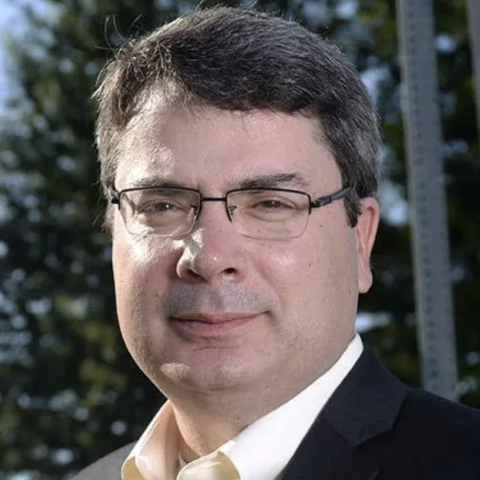
Dr. Hunter is a Professor in the School of Civil and Environmental Engineering at Georgia Institute of Technology. His primary teaching and research interests are in transportation operations and design, specializing in adaptive signal control, traffic simulation, and arterial corridor operations. Dr. Hunter obtained his B.S. in Civil Engineering from Rensselaer Polytechnic University (1992), his M.S. in Civil Engineering from the University of Texas at Austin (1994), and his Ph.D. in Civil Engineering from the University of Texas at Austin (2003). After obtaining his M.S. he worked as a transportation engineer for several years at the Sear-Brown Group in Rochester, NY.
Dr. Hunter has been highly active in research, teaching, and service. He has been principal investigator of sponsored research for a variety of sponsors including local, state, and federal agencies, and industry. Dr. Hunter has led two significant transportation research centers, the Georgia Transportation Institute (GTI, 2012 to present) and the National Center for Transportation Systems Productivity and Management (NCTSPM, 2012 to 2017). Dr. Hunter is actively researching simulation, digital twins, connected and autonomous vehicles, signal control optimization with AI, smart cities, connected infrastructure, and disruptive and emerging technologies within the transportation systems context.
Research
Dr. Hunter has extensive research experience in simulation, digital twins, hardware-in-the-loop-simulation, and software-in-the-loop-simulation. His projects have explored the modeling of arterials, freeways, corridors, and parking facilities. He has extensively studied adaptive control, emerging technologies, signal optimization with AI and Reinforcement Learning, etc. His efforts have included two real-time corridor digital twin models, one in Atlanta, GA, and one in Chattanooga, TN. He has studied emergency vehicle preemption and transit priority, including multi-agent Reinforcement Learning (DQN and PPO) optimization. Dr. Hunter has developed traffic flow simulations for capturing the effect of aggressive human driver interaction with autonomous vehicles on traffic. Dr. Hunter has also undertaken numerous efforts in the development and analysis of performance metrics. He has conducted safety research, studying the impact of various safety treatments, such as the mode of flash at an intersection, don't block the box treatments, innovating signage and lane markings, etc.
Education
Ph.D., Civil Engineering, The University of Texas at Austin, 2003
M.S., Civil Engineering, The University of Texas at Austin, 1994
B.S., Civil Engineering, Rensselaer Polytechnic Institute, 1992
Associate of Science, Engineering Science, Hudson Valley Community College, 1990
Teaching
Dr. Hunter’s teaching is practice focused, teaching at the undergraduate and graduate level. Topics in his courses include transportation safety, operations, design, and planning. Dr. Hunter stresses engineering fundamentals, innovation, and intuition, as well as exploring the application of emerging methods such as AI and RL. His courses stress the importance of the design user, that is, ensuring that our transportation operations and design are focused on the strengths and capabilities of the people that use the transportation system, whether driving a vehicle, crossing the street, riding a bicycle or scooter, or riding transit. Recently, Dr. Hunter developed a new course merging a common simulation tool utilized in practice with fundamental concepts, pulling away the black box nature of many simulation tools.
Distinctions & Awards
- Winner of the Transportation Research Board D. Grant Mickle Award (2019)
- Best Paper Award – Transportation Research Board, Operational Effects of Geometrics Committee, AHB65. (2019)
- Mobility Award. City of Atlanta’s North Avenue Smart Corridor Project (Project Co-PI). Smart City Expo World Congress. Barcelona. November 2018. (2018)
- Best Abstract Award, PTV America’s User Group Meeting (2011)
- Best Paper Award, Principles of Advanced and Distributed Simulation Conference (2010)
- Transportation Research Board Operational Effects of Geometrics Committee, Best Paper Award (2010)
Publications
- Mers, B., M. Hunter, K. Watkins. Demographic Breakdown of Transit Rider Satisfaction. Transportation Research Record, Journal of the Transportation Research Board, Sage Publications, 2678 (6), 656-666. June 2024.
- Saroj, A., S. Roy, A. Guin, M. Hunter. Impact of Connected Corridor Volume Data Imputations on Digital Twin Performance Measures. International Journal of Transportation Science and Technology. Elsevier. June 2023.
- Guin, G., K. Robinson, H. Unthank, S. Roy, and M. Hunter. Impact of Restricted Crossing U-Turns on Vehicular Emission, Transportation Research Record, Journal of the Transportation Research Board, Sage Publications, May 2023.
- Manjunatha, P., S. Roy, L. Elefteriadou, A. Guin, and M. Hunter. Evaluation of the Operational Effects of Autonomous and Connected Vehicles through Microsimulation. Transportation Research Record, Journal of the Transportation Research Board, Sage Publications, December 2022.
- Saroj, S., A. Guin, and M. Hunter. Development of a Connected Corridor Real-Time Data-Driven Traffic Digital Twin Simulation Model. Journal of Transportation Engineering, Part A: Systems. American Society of Civil Engineers, Volume 147, Issue 12, Dec 2021.
- Sustainable Communities
- Built Environment
- Electric Vehicles
Electric Vehicles; Smart Infrastructure